 xuyeeggtray
- Switch Language
Search the whole station
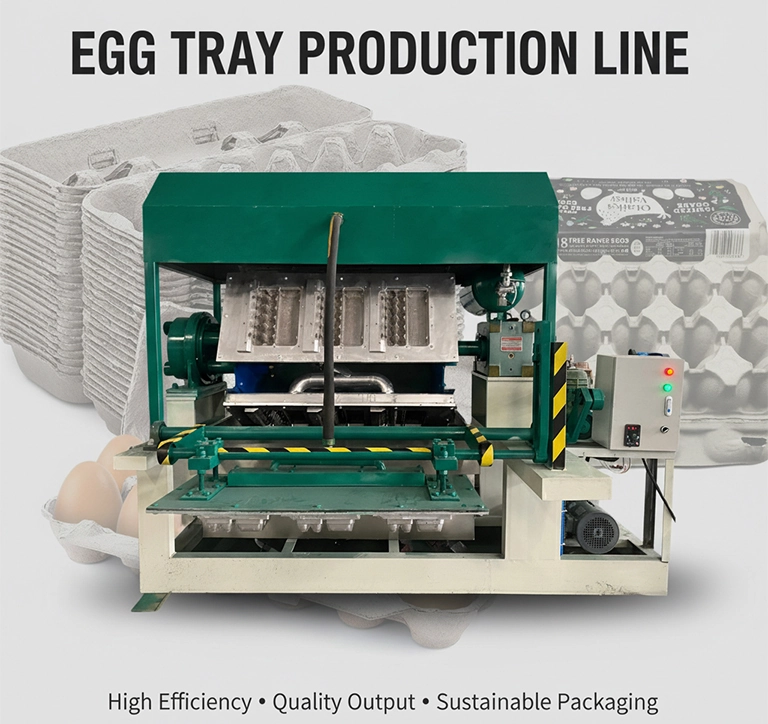
The Egg Box Making Machine is an advanced molded pulp production system designed to manufacture paper egg boxes from recycled waste paper. These egg boxes are widely used for retail egg packaging because they provide better protection, convenient storage, and an eco-friendly alternative to plastic containers.
With increasing global demand for sustainable packaging solutions, the paper egg box making machine has become a popular investment for packaging companies and poultry farms. It allows manufacturers to produce durable egg boxes efficiently while utilizing low-cost recycled materials.

The production of paper egg boxes involves several key stages. Each stage is designed to ensure that the final product is strong, uniform, and suitable for commercial egg packaging.
The production process begins with waste paper such as newspapers, cartons, or cardboard. These materials are mixed with water in a pulping system to create paper pulp.
The pulp is then filtered and refined to remove impurities and ensure consistent quality.
The prepared pulp is transferred to the egg box forming machine, where special molds shape the pulp into egg box structures. Vacuum suction technology helps form the pulp evenly on the molds.
Freshly molded egg boxes contain a high level of moisture and must be dried before further handling. Manufacturers can choose from several drying methods:
The drying method usually depends on the production scale and local climate conditions.
For higher quality egg boxes, a hot pressing system can be used to improve product strength and appearance. This step also ensures smooth surfaces and better product shape.
One of the biggest advantages of the egg box making machine is its environmentally friendly production process. The machine uses recycled paper materials, helping reduce waste and promote sustainable packaging.
Paper egg boxes provide better protection compared to many traditional packaging materials. Their molded pulp structure absorbs shock and reduces egg breakage during transportation.
Egg box machines are available in different production capacities, making them suitable for both small businesses and large-scale packaging factories.
Many modern machines are equipped with PLC control systems that allow automated forming, drying, and stacking operations. This significantly reduces labor costs and increases production efficiency.
The egg box production machine can process many types of waste paper materials, including:
These materials are mixed with water and converted into pulp for molded packaging products.
Depending on production needs, manufacturers can choose from different machine configurations.
This type is ideal for startups or small farms that require a moderate production volume. It offers low investment and simple operation.
Semi-automatic machines combine manual and automatic processes, providing improved efficiency compared with small machines.
Fully automatic production lines integrate pulping, forming, drying, and stacking systems. They are designed for high-capacity industrial production and can produce thousands of egg boxes per hour.
Egg boxes produced by the egg box making machine are widely used in the food packaging industry. Their applications include:
Paper egg boxes are particularly popular because they are lightweight, recyclable, and easy to store.
The global poultry industry continues to grow, creating a strong demand for reliable egg packaging solutions. As environmental regulations become stricter, many companies are replacing plastic packaging with biodegradable pulp packaging.
Investing in an egg box making machine allows businesses to enter a growing market with long-term potential. With relatively low raw material costs and stable demand, egg box production can generate attractive profits.
| Model | XY0301 | XY0401 | XY0403 | XY0404 | XY0408 | XY0508 | XY0608 | |
| Capacity (pieces/h) | 800-1000 | 1200-1500 | 2000 | 2200-2500 | 3500-4500 | 5000-5500 | 6000-6500 | |
| Forming Mould Quantity | 3 | 4 | 12 | 16 | 32 | 40 | 48 | |
| Total Power (kw) | 33 | 42 | 53.7 | 82 | 127 | 161 | 223 | |
| Electricity Consumption (kw/h) | 23.1 | 29.4 | 37.59 | 57.4 | 89 | 113 | 156 | |
| Labor Force | 3-5 | 4-6 | 4-6 | 4-6 | 4-6 | 5-7 | 6-8 | |
| Material Consumption (kg/h) | Paper | 85 | 102 | 170 | 212 | 298 | 425 | 520 |
| Water | 255 | 306 | 510 | 636 | 1147 | 1275 | 1560 | |
| Fuel Consumption | Coal (kg) | 50 | 60 | 83 | 104 | 125 | 208 | 208 |
| Natural Gas (m3) | 22-32 | 26-36 | 37-47 | 46-56 | 56-66 | 92-103 | 92-103 | |
| Diesel (kg) | 18-28 | 22-32 | 30-40 | 38-48 | 46-56 | 77-87 | 77-87 | |